
Most leaders are quick to identify the obstacles standing in their way.
A lack of resources. Organisational politics. Difficult stakeholders. An underperforming team. Market pressures.
And while these external factors are real, they are often not the biggest barrier to leadership effectiveness.
In our experience coaching senior executives and business owners, some of the greatest constraints on leadership performance come from within. They are the assumptions, stories and self-limiting beliefs that shape how leaders think, make decisions and interact with others—often without even realising it.
The challenge is that these beliefs are rarely obvious. In fact, many of them were instrumental in helping leaders achieve success in the first place.
The attention to detail that helped you build your reputation may become micromanagement. High standards can evolve into perfectionism. Confidence can become certainty. A strong sense of responsibility can make delegation feel uncomfortable.
The very qualities that helped you succeed at one level can become the factors that limit your effectiveness at the next.
Common Self-Limiting Beliefs in Leadership
Research and executive coaching experience suggest that several self-limiting beliefs appear repeatedly among successful leaders:
- I need to be involved in everything.
- I can’t make a mistake.
- I know the right answer.
- I can’t say no.
- If I can do it, everyone else should be able to.
- I’m an imposter
At first glance, these beliefs may seem harmless—or even admirable. However, their impact can be significant.
A leader who believes they need to be involved in everything may struggle to delegate, creating bottlenecks and slowing decision-making.
A leader who believes they cannot make mistakes may become overly cautious, delaying important decisions while seeking more information, more consensus or more certainty.
A leader who believes they always know the answer may unintentionally discourage challenge, reduce collaboration and limit innovation.
Over time, these patterns affect not only the leader’s performance but also the performance of the people around them.
Why Successful Leaders Are Particularly Vulnerable
Many self-limiting beliefs originate from experiences that were once helpful.
Perhaps being the person with the answers earned recognition early in your career. Maybe working harder than everyone else accelerated your promotion. Perhaps avoiding mistakes protected your reputation.
The problem is that leadership changes as responsibilities grow.
The behaviours that make an excellent technical specialist or functional manager are not always the same behaviours that make an effective senior leader.
Leadership at more senior levels often requires letting go of certainty, trusting others, empowering teams and making decisions with incomplete information.
This is why leadership growth frequently involves unlearning as much as learning.
The Role of Cognitive Behavioural Therapy (CBT)
One of the approaches we frequently draw upon in executive coaching is Cognitive Behavioural Therapy (CBT).
At its core, CBT recognises that our thoughts influence our emotions, which influence our behaviours and ultimately our results.
Take delegation as an example.
Many senior leaders genuinely want to empower their teams, yet struggle to let go. When explored through coaching, the issue is often not capability but belief.
The underlying thought might be:
“If I want it done properly, I need to do it myself.”
Or:
“It’s quicker if I do it.”
Or even:
“If my team gets it wrong, it reflects badly on me.”
These beliefs create predictable behaviours. The leader stays involved, checks progress excessively, steps in too quickly, solves problems that others could solve themselves and ultimately becomes a bottleneck.
The result is frustration on all sides. The leader becomes overwhelmed while team members feel less trusted and take less ownership.
CBT helps leaders identify these patterns and challenge the assumptions behind them.
A more productive belief might be:
“My role is not to do the work. My role is to ensure the work gets done.”
Or:
“People grow when I give them responsibility, not when I rescue them.”
When leaders adopt these beliefs, delegation becomes easier, ownership increases and the leader creates capacity to focus on higher-value activities.
Unleashing Leadership Growth
In our work with leadership teams, we often talk about the importance of developing focused and effective leaders as one of the key drivers of sustainable growth.
Yet effectiveness is rarely limited by intelligence, experience or technical expertise. More often, it is constrained by the beliefs that shape how leaders use those strengths.
The good news is that beliefs are not fixed.
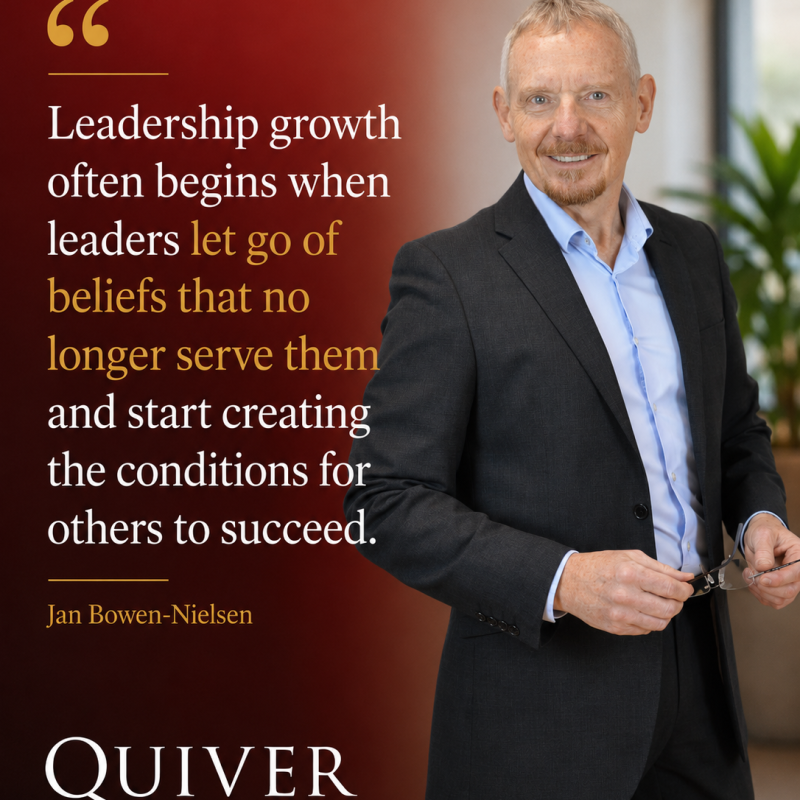
When leaders learn to identify and challenge the assumptions that no longer serve them, they unlock new levels of performance, create more ownership within their teams and become more effective leaders.
Leadership growth is rarely about learning to do more.
Often, it is about learning what to let go of.
Back to News & Blogs Overview